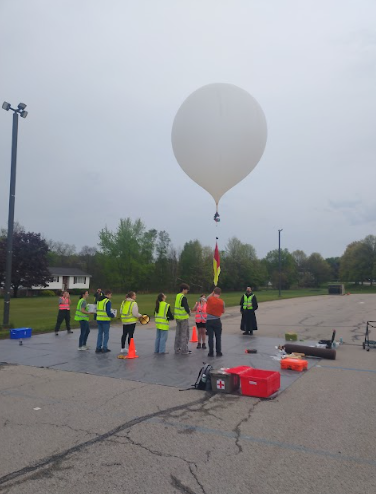
After more than a year of coding, building and testing, a team of students from the Astronomy club, the Pennsylvania Junior Academy of Science club and Saint Francis University successfully launched a weather balloon into the upper atmosphere.
“Our weather balloon project was something that we worked on with Saint Francis University over the course of about a year,” sophomore Delaney Beecher said. “We created a CubeSat, which is a type of nanosatellite that can be programmed to collect a variety of scientific data. We programmed our CubeSat to collect atmospheric temperatures and connect to a GPS.”
The balloon rose 72,000 feet into the Earth’s atmosphere to collect data on temperature, altitude and GPS.
“Because of the GPS attached to our CubeSat, we were able to connect it to a software that can track our balloon,” Beecher said. “Using this, we were able to see where it was moving, how fast it was moving, the altitude that it reached was over 72,000 feet, which is over twice as high than the altitude that jets typically reach.”
Students have been working on this project since last school year. The project did not just have students build and code, but they also took field trips to learn more about the balloon launch.
“There were two different collaborations that we had with Saint Francis,” adviser James Krug said. “The first one, Mr. Borst and myself worked with a group of students ever since last school year. We took a couple field trips to the Curry building in downtown Altoona, owned by Saint Francis, and we did some space balloon launch workshops. There, students actually designed a simple payload that went up on an upper atmospheric balloon. That one already took place a couple weeks ago.”
The team faced some challenges while working towards this launch.
“Some conflicts that we faced were with our coding and GPS,” Beecher said. “We ran into some issues with our coding, but we were able to quickly figure it out. Our GPSs were not all that great in quality, so they were not taking the most accurate measurements. Because of this, Saint Francis brought us new GPSs to attach to our CubeSat.”
“The biggest challenges for us were probably dealing with the coding for the computer,” senior Camille Krug said. “Wiring the computer was pretty easy, but doing the code was a challenge as we kept getting errors.”
One of the big issues was finding time for the teams to meet and work on the projects.
“I’d say the biggest obstacle is that Saint Francis wants the best of the best for students, and we absolutely provided that for both the teams,” J. Krug said. “Our CubeSat team in particular, were absolute dream teams. We had some of the top students in the junior and senior classes. But the trade off that sometimes a university, like Saint Francis, doesn’t understand is that all of these kids are the top students, but they also are so heavily involved in other projects. One of the challenges that Mr. Borst and I are trying to relay to Saint Francis, your students live there 24/7, they can do this research. Our students are very tightly scheduled, they have a lot of activities. So one of the biggest challenges is trying to find time that all the high school students can meet. The opportunities to meet and collaborate aren’t quite the same.”
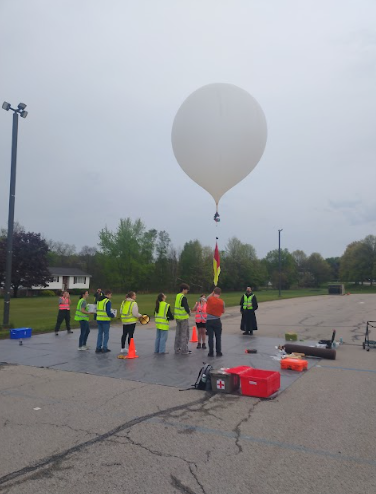
The launch of the balloon took place very early in the morning. A small group of students met Saint Francis’s team at Indiana, Pa. to prepare for the launch.
“Launch day was very exciting,” Beecher said. “We left the school at 4 a.m. to prepare to meet with Saint Francis for our launch. After a long drive, we arrived in Indiana. We started bringing out the materials to set up, and then got to work. We wanted to launch it quickly, but without damaging anything. The balloon was extremely large, and it was made out of a very thin latex material, making it extremely fragile. After inflating and assembling, we gently lifted it up to launch.”
The balloon was in the Earth’s atmosphere for about an hour and a half before it started to descend.
“They gained mathematics and collaboration skills,” J. Krug said. “I think the biggest thing was seeing how projects and research are done at the collegiate level. This is more wide open, like in our cube satellites projects we’re working on, we’ve been visited three times now by an MIT professor named Dr. Jerry Mendenhall. He’s a Saint Francis alumni and he’s working with us on the projects. Our teams are divided into student programming teams, structural engineering teams, camera teams and social media teams. I think it’s also a good experience for students seeing how research is actually undertaken at both the college and professional level.”
Along with working on the weather balloon, the team has also been working on a second project.
“The second project is a collaboration with Saint Francis University and MIT,” J. Krug said. “It is a payload going up on a NASA mission in December of 2027. Our group is in charge of the aurora imaging that is supposed to snap faint pictures of auroras, which are light based phenomena in the upper atmosphere of Earth.”
This poses an exciting opportunity for several students, including Beecher.
“I think that the most exciting part for me personally was preparing for the launch,” Beecher said. “I was very excited to see the whole project and process come together to put this balloon up, and at the end, I got the opportunity to actually release the balloon.”