
One of the foremost focuses of the AASD is the safety of those within its schools. From drills to assemblies to trainings, many precautions are in place to assure, should an incident occur, both students and staff will be safe. Preceding the start of the school year this year, an active shooter drill training was held for AASD staff at all levels to simulate what could happen should a shooter enter the building. In today’s world, training of this nature is only beneficial to the schools. Though not to the full extent of the staff training, drills like this should also be held involving students to assure they know what to do in the instance their day takes an unfortunate turn for the worse.
In 2024, 330 school shootings were recorded across the US, 24 of which were categorized as active shooter incidents. These incidents resulted in 106 total casualties of students, school staff and law enforcement. Of these 24 active shooter incidents, three were categorized as mass shootings. In a world where these incidents are a frequent reality, it is of utmost importance that all possible measures are taken to assure the safety of both students and staff should one occur here.
In 2023, several AASD schools were put into lockdown as a result of a shooter threat which was later declared a hoax. Though it is now known the threat in this instance was a hoax, the panic that ensued for many students and staff was very real, and many today can still recall their feelings during the lockdown. This incident put into perspective how necessary it is that everyone is prepared in case another incident should occur where a real threat is posed.
Three different kinds of drills are differentiated between in the instance that there is a potential threat to students: stay put, lock down, and shelter in place. In a stay put, happenings continue as normal, but entry and exit of the building is not permitted. In a shelter in place, classroom happenings continue normally, but nobody is permitted to be in the hallways and entry and exit of the building is not permitted.
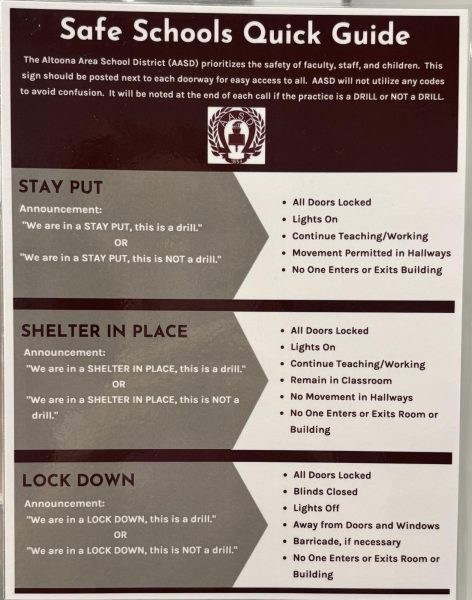
In a lockdown, classroom doors are to be locked, lights are turned off and blinds closed, and measures needed to hide or barricade are taken as needed. While there are posters in classrooms to remind students and teachers what the different protocols for these are, the reality is that these are not one-size-fits all protocols. The AAHS is a very unique school featuring many different types of classrooms to adapt to the different needs of classes and to interrupt what would otherwise be a very monotonous day. While this is in many instances beneficial, it must also yield differences in protocol for students in certain rooms.
Some rooms are equipped with vast storage. This can be especially helpful in an instance where students need to hide. For students in some other rooms; however, the same opportunities to hide are not available. The B building features several classrooms with almost entirely glass walls, making hiding in them nearly impossible. For these rooms, measures need to be taken to assure that students would be able to conceal themselves, and students who are in these classes need to be made aware of the different protocols in place.
In addition, though there are drills held for stay puts, lockdowns and shelter in places, they are few and far between. Like drills for the possibility of a fire which are held monthly, regular drills need to be held so that students are comfortable with the procedures in place for when potential threats are in the school. The August drill for staff was an extreme but realistic training. While the full extent of training is not necessary for students, it would be beneficial to students to have some more preparation under their belts.
All in all, more preparation for a shooter incident can only benefit the schools’ students and staff should one occur.