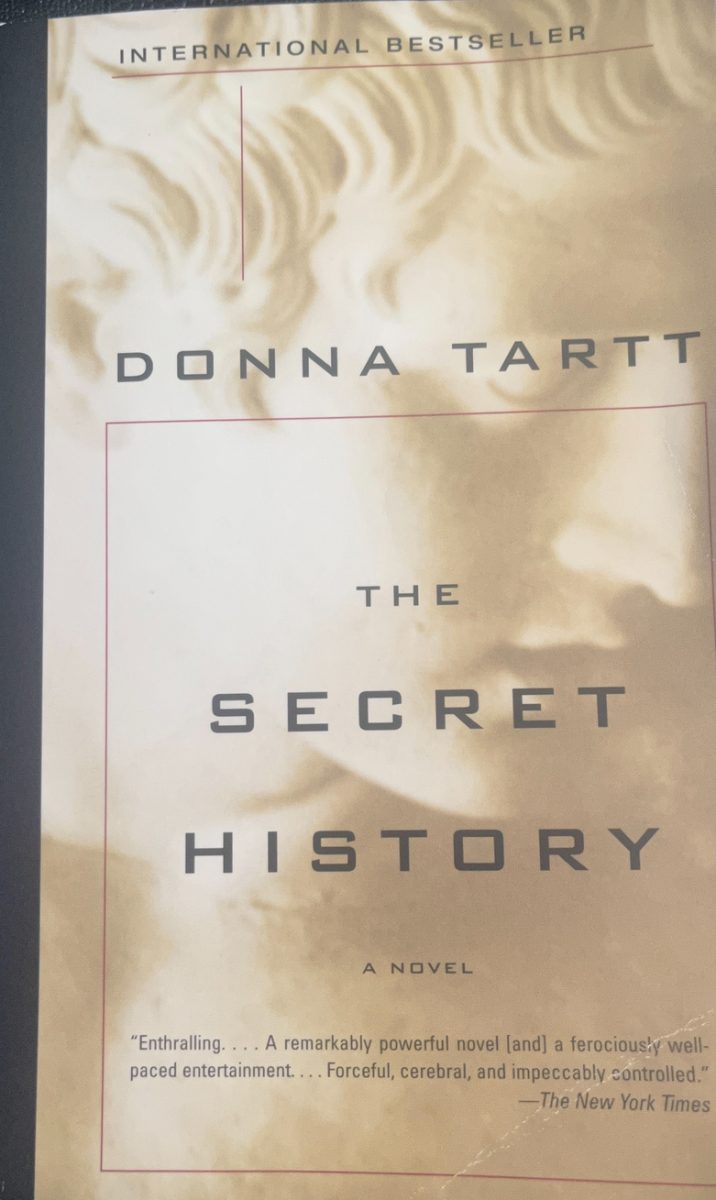
The first half of Donna Tartt’s dark academic thriller, “The Secret History” pulls readers into a close-knit,Vermont college town in the late twentieth century. It follows the first person account of Richard Papen, a 28-year-old Californian who transferred to Hampden College and his life experiences.
Readers learn that he enrolls in Greek Studies, which will change the trajectory of his life forever. The professor is very particular about his students and is not liked by the rest of his colleagues. This displays an interesting theme of alienation in the five (soon to be six) students.
The beautifully written prologue coincides with the ending of part one. It begins, “The snow in the mountains was melting and Bunny had been dead for several weeks before we came to understand the gravity of our situation.” I absolutely love how readers know from the first sentence of the novel who dies and gets a sense of who committed the crime. It kind of creates a sense of “why” rather than “whodunnit.”
Near the end of the prologue Richard recalls an exchange between Henry, who is the mastermind of the Greek group of students, and Bunny, their friend who they eventually kill, ‘What are you doing up here?’ Said Bunny, surprised when he found the four of us waiting for him. ‘Why, looking for new ferns,’ said Henry.’ This piece of dialogue is not only seen in the prologue, but finishes part one of the book as well. I love how Tartt stylized this because it ties together the ends of the sections.
Style is strongly evident in the novel. The author writes phrases in Greek and Latin through dialogue, alludes to Greek tragedies and classical mythology, creates a moody setting and reminds the readers that the novel is a story being told by a much older version of one of the characters.
As I was reading, I found myself having to look up what certain dialogue was translated to in English and what certain allusions meant in history. I liked this aspect of it because it felt like I was learning something outside of the traditional plotline.
Tartt’s imagery is unmatched. From feeling like I was the one crunching the crimson and copper-colored leaves that scattered the lawns of the cozy, Vermont college, to being able to see the depths of the ravine before (what seems like) the fall (I crucially do not mean the season), I could fully immerse myself into the novel.
Although there are many pros of the book, this is only half of the plotline and I feel like it has been drug out for ages. “Book 2” begins on page 275 and I cannot seem to fathom what else there could possibly be to say in the next 284 pages.
I predict she will write about where the friends, specifically Richard, are now in their lives many years after their crime. I also could see her writing about a funeral of some sort or if the students had to serve time. There are many ways she could go with this, and I am excited to see where she leads me in this New England tragedy next.