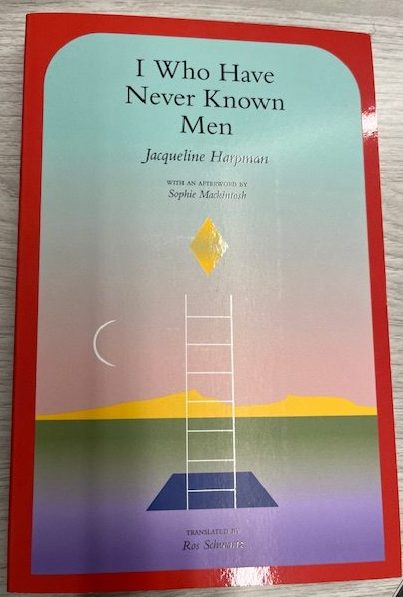
The dystopian novel, “I Who Have Never Known Men” by Jacqueline Harpman follows an unnamed narrator in a post-apocalyptic world trying to survive in the vast nothingness of plains and bunkers. The narrator grows up as a child in a cage with thirty-nine other women who were drugged and taken from their daily lives. They eventually escape their underground prison and continue their journey through a very different world. I loved the imagery incorporated to fully immerse me into this world. I kind of felt like I was on the journey with the protagonist myself.
This novel is a treasure chest for thematic messages and symbolism. Themes of isolation, self-discovery and womanhood are beautifully articulated as well as symbols of perpetual light, counting and time. Given Harpman’s psychoanalyst background, it isn’t surprising that she is very successful in conveying these. I really appreciated her skills and knowledge she gained through her career as used in this novel.
I read “I Who Have Never Known Men” in a single day. Over the one hundred and sixty-four pages, there were no chapters. It was just a straightforward bunch of pages that allowed the reader to begin and end wherever they wanted. I really enjoyed the formatting and it made for an easy read.
I think the novel is an essential read for lovers of dystopian fiction and young women in general. The conversation around women’s bodies, minds and relationships in the novel act as a building block for feminist literature which I try to educate myself with when I can.
Critics compared Harpman to a modern and feminine Franz Kafka. Having read “The Metamorphosis” in English this year, I can see the parallels between the authors. I think Kafka’s demonstration of him and his father’s relationship definitely relates to the relationship he would have wanted as seen in “I Who Have Never Known Men.” Between the unnamed narrator and Anthea, an older and wiser woman in the novel, a motherly bond is formed whereas the unnamed narrator is really an orphan.
I loved the style of this novel because Harpman does a nice job of making it a letter that the unnamed narrator wrote before she dies. I think this added a sense of individualism because the narrator is not actually completing these tasks in the present, but taking the narrator back in time for her journey as she is already dead.
I would recommend this book to anyone who wants to broaden their horizons in the world of feminist literature. I think it is a must read for women in any stage of their lives.