
In the midst of the 21st century in America, cellphones are practically inescapable. People use them for everything from communicating to ordering food to tracking their health. But with this substantial usage comes concerns, especially regarding children and teenagers. Many fear that dependence on cellphones will prove detrimental to their development.
Physical education teachers Thomas Palfey and Paul Picciotti decided to take action in accordance with the school’s policy: “Students are not permitted to carry cellular phones and other audiovisual devices/PEDs that are not school-issued on them during the school day.” Then they turned their phone collection into a friendly competition.
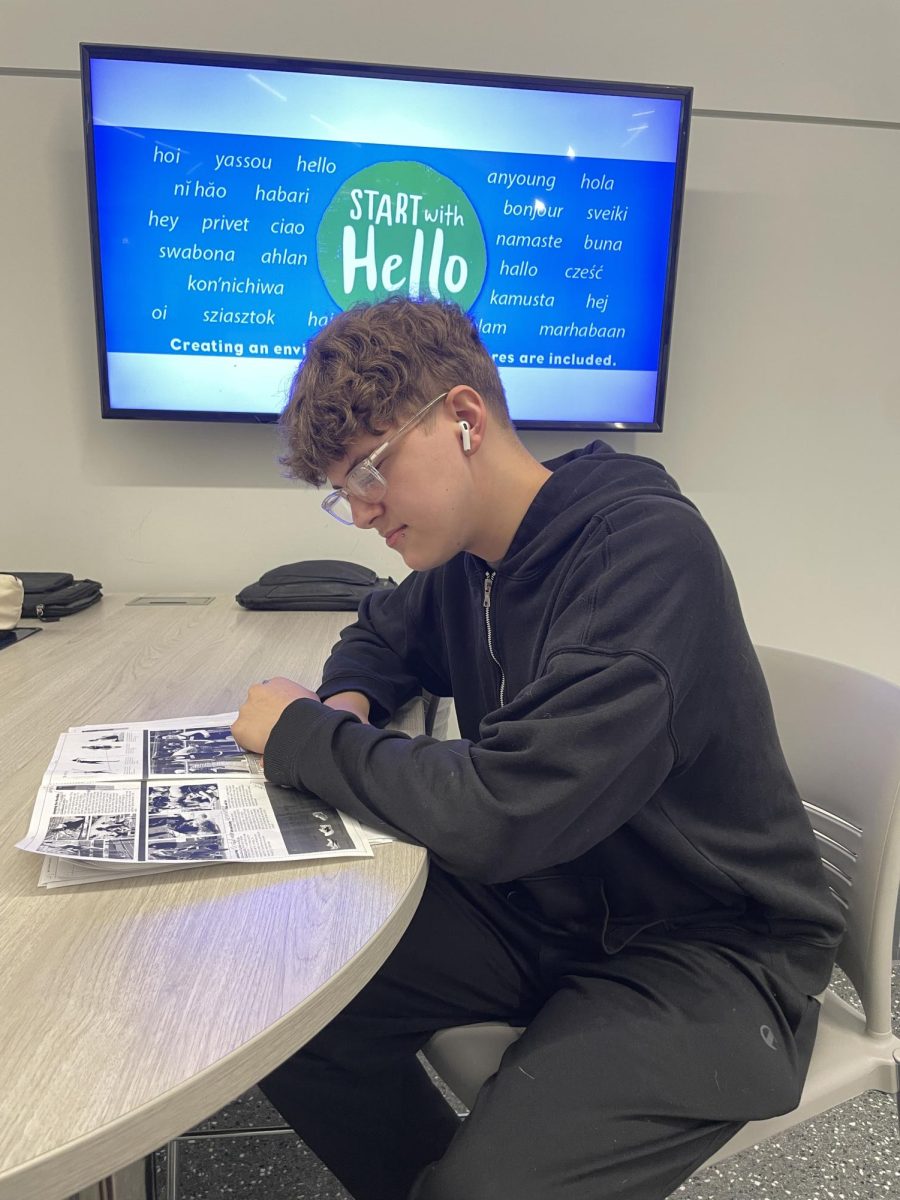
“It was more or less just a volcano of seeing kids with their earbuds upstairs all the time, so that’s where it [the competition] came from,” Picciotti said. “Palfey and I like to [make taking phones] a little bit of a surprise, so it was that and just an overflow of seeing them [wearing earbuds] all the time.”
Palfey compared their collection to police officers giving speeding tickets.
“It’s like how a trooper on a highway can choose to watch you speed by and do nothing; they can chase you down, pull you over and give you a warning, or at the end of the month, they have their quota to make, and they’re going to get everybody,” Palfey said. “It happened to be quota day those two days that Mr. Picciotti and I were in competition.”
Over two days, the teachers collected a total of 35 cellphones.
“I got 18 and Picciotti got 17, so I beat him by one,” Palfey said. “We’ve had vape competitions before, and he crushed me. I’m not as good at picking those people out, but when it [an earbud] is in your ear I can see it.”
After confiscating students’ phones and earbuds, Palfey took them to the main office where their parents or guardians picked them up. The teachers then typed up the reports.
“My whole lunch period was spent writing them up, so I didn’t get to eat,” Palfey said.
According to Palfey, the teachers who take away these items are judged unfairly.
“If everyone in both buildings did what they’re supposed to do, then we’d never be the bad guys that we’re made out to be,” Palfey said.
Picciotti defended their competition by citing the aforementioned school policy.
“I’m just following school policy; that’s pretty much all I can do,” Picciotti said. “Do I think they’re a big deal? Not really, but that’s not my decision. I know other school districts do different things, but we don’t.”
Palfey also defended their phone collection by citing the “broken windows theory,” which dictates that the allowance of smaller crimes leads to larger ones.
“It [the phone collection] is like if you use the broken windows theory from New York, they got people for the smallest offenses—like jumping over the line on the subway—and those were the same people committing the bigger crimes,” Palfey said.
However, opinions differ on if this form of prevention is effective.
“I guarantee that half the discipline [instances] will go down if we’re allowed to have them [phones],” senior Tristan Sunderland-Ebersole said. “How many kids do you know who haven’t done anything else and get busted just for having them in their pocket?”
There is also concern about losing the safety that cellphones can provide.
“It’s the 21st century, and it [a phone] is the newest safety measure,” senior Olivia Fortson said. “Our freshman year, when we had that lockdown, I remember so many kids wanted to contact their families, and we should be able to do that.”
On the other hand, some students are also in favor of limiting the presence of phones.
“I believe that students should keep their phones shut off and not be allowed on them during the day,” sophomore Evan Getty said. “Either [keep phones] in a locker or in a safe spot in a class. Having phones is a distraction and will disrupt the peacefulness of the environment.”
Coincidentally, around the same time as their competition, Senate Bill 1014 was presented to the House of Representatives Education Committee of PA. The bill proposes a bell-to-bell phone-free school day. It was passed the same day, and will go on to the PA House of Representatives, where a final decision will be made.
“I hope we do it [the phone ban] in PA,” Palfey said. “I hope they don’t bring them [phones] at all, because then school will be back to where it’s supposed to be, which is you guys learning.”
The bill is also a subject of debate amongst students.
“I think we should be allowed to have them as long as we’re not on them during class time, but we should be able to be on them in the hallways and at lunch,” Fortson said.
“I feel like it [the bill] is necessary for the teachers to be able to educate the students without them being distracted, also eliminating a way for students to cheat and get out of work,” Getty said.