Three longtime educators to retire at the end of year
For health and physical education teacher Amy Palfey, the journey into teaching was not part of her original plan. Instead, it developed through reflection on her personal strengths and interests during her college years.
“When I went to college, I majored in business, and I knew I didn’t want to be in business, so I went to my adviser, and he asked me what I liked to do,” Palfey said. “I liked working out, and I liked reading health magazines. And then he said, ‘What do people say you’re good at?’, and people always wanted me to babysit their kids. And so he said, ‘You should put that into being a teacher.’”
According to Palfey, throughout her career, the most meaningful outcomes of teaching were often not immediately visible for her. Instead, that impact became clearer over time, as former students reflect on their experiences.
“The students have been the most rewarding part,” Palfey said. “Knowing that you make a difference, but it’s usually not at the time when you’re making a difference.”
These delayed moments of recognition often come through continued connections beyond graduation, reinforcing the long-term nature of a teacher’s influence.
“It’s later when students will reach out to you or you get to see them out working, and they’ll remember you,” Palfey said. “It’s just the connections that you get to make with students, that’s definitely the most rewarding part.”
Drawing on experience across multiple grade levels, Palfey emphasized that teaching requires flexibility and an ability to adapt to different learning environments and the needs of students over time.
“I think a great teacher is probably someone who is open to change and is able to evolve,” Palfey said. “They don’t have a fixed mindset, and I think they’re able to connect with people no matter the age. I taught kindergarten, and now, I’m ending my career here at the high school, so all different grade levels.”
Trust also plays a central role in the learning process, shaping how students engage both academically and personally in the classroom.
“It comes down to just being able to make connections with students, and trying to understand where they’re at and meet them there,” Palfey said. “Knowing that learning will take place when a student knows that they can trust you and that you genuinely care about them.”
As she approaches retirement, there is a balance between appreciation for her career and anticipation for time with family.
“I’m so excited, I am going to miss teaching, honestly,” Palfey said. “This is my calling, and I do feel like it was something I was meant to do. However, I am getting an opportunity to watch a grand baby in the future who will be born this week.”
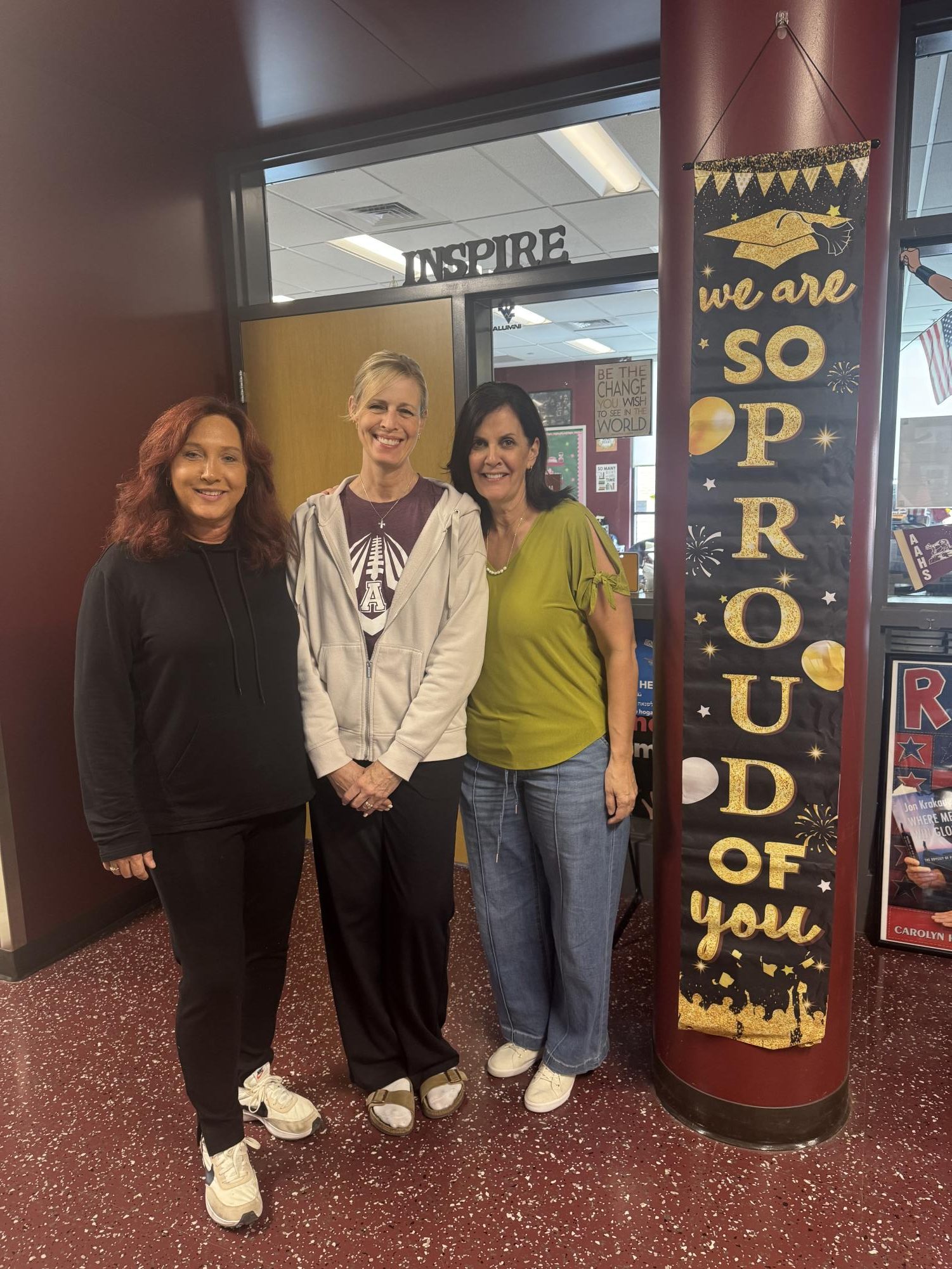
This will be Palfey’s 30th year teaching. She was involved as an assistant girls basketball coach in the 1990’s, and back again for a few more years starting in 2018. She is also an assistant student council advisor, the Mountain Movers faculty representative and a teacher for ACA health classes.

Another retiring educator, guidance counselor Julie Yahner, said her perspective on teaching has been shaped by years of observing students not only in academic settings but also through their responsibilities and efforts outside of school.
“I have absolutely been so impressed with Altoona kids because they work hard, not only in school, but out of school,” Yahner said. “I’m so impressed with so many kids. It gives you a wider perspective on absolutely everything.”
Her decision to pursue a career in education emerged gradually through direct involvement in school environments, where she found consistent interaction with students to be both meaningful and motivating.
“I worked a lot in the schools, and I really loved going into the schools and working with the kids,” Yahner said. “Then I thought that, since I love working with kids, ‘Wouldn’t it be great to work with kids every day?’. That was sort of like an inspiration, just like to work with young people.”
Yahner said maintaining student engagement often required adaptability in the classroom, including finding ways to keep students attentive while also building a supportive environment.
“It’s so important to make sure the kids know that you care about them—that you truly care about them,” Yahner said. “And you have to be creative. Sometimes you have to be an entertainer. The bottom line is just letting kids know that you really care about them and are there for them.”
Looking ahead, retirement will allow Yahner to devote more time to family life and responsibilities that extend beyond her professional role.
“My two sons are taking over our farm, so I want to help them and my husband as we transition into it being their farm; I would love to be outside more and work with them.” Yahner said. “And the other thing is: I have my third grandchild who’s going to be born in a couple weeks, so I want to be a grandma and help babysit them.”
Yahner started working as a counselor at Roosevelt Junior High in 1993. She worked at Altoona Area Junior High when Keith Junior High and Roosevelt Junior High combined in 2008. She then started out at the high school during the 2018-19 school year. Yahner worked with and for many different educators, and assisted with the start of Rachel’s Closet.
History teacher Carolyn Kline, the third educator preparing to retire, said her interest in teaching began early, and was influenced by experiences at home that resembled a classroom setting.
“I had a sister who was four years younger than me, and my dad had put a blackboard up in our basement, and I remember taking her down there and working math problems with her,” Kline said. “I was the teacher and she was the student. I’ve always been interested in that, and I’ve always loved history.”
Throughout her career, she found value in moments when students became actively engaged in lessons, particularly when they demonstrated understanding through discussion and participation.
“I love when I have a great class, and we can make connections, and I can see that light bulb go on in their heads, and we can have fun, but also learn along the way,” Kline said. “That’s helped keep me young at heart over the years.”
She also reflected on earlier challenges in her career, including navigating professionalism with students while working with fewer available teaching resources than today.
“You want to be the one all the kids like, and you have to make that separation between being friendly and being friends, and that was tough to negotiate,” Kline said. “We also had none of the resources that people have today. On my first day, I got the student version of the textbook, and that was it, so I had to make up all my own lesson plans, find my own resources.”
Kline said her philosophy for teaching centered on the overall experience students carry with them after leaving the classroom, rather than focusing solely on academics.
“I want to be that teacher that, when my children look back on their education, they feel love in their hearts, have a smile on their face and can truly say that they knew I cared,” Kline said. “It just comes down to realizing that it’s not so much the subject matter, but the feeling.”
As she looks toward retirement, Kline said she plans to remain active in the community and pursue interests that were previously limited by her teaching schedule.
“I’m looking forward to reading a lot more,” Kline said. “I do want to get involved in community things, helping out with Baker mansion, helping out with Salvation Army, Mountain Lion backpack, just stuff that I couldn’t do before.”
This will be Kline’s 36th year as an educator for the Altoona Area School District. She has been the Mountain Lion Maniacs advisor for roughly the past 15 years, and has been in all of the teacher talent shows except one. She has volunteered for the Toona Tune up yearly, and is an active member of the Lighthouse Team. She has also been a volunteer coach for Juniata Gap basketball and volleyball teams when her children attended there, as well as a coach and assistant coach for AIYBL (Altoona Independent Youth Baseball League) and the KGSL (Keystone Girls Softball League) summer baseball and softball leagues.
As these educators prepare to step away from their roles, their reflections highlight a shared emphasis on adaptability, connection and long-term impact. While their daily presence in the classroom will come to an end, their influence is expected to continue through the students and community they have shaped.