Of all of the outstanding movies released in 2025, “Frankenstein” stands out as one of the best. From the genius of director Guillermo del Toro (also known from films such as “The Shape of Water” (2017), “Pan’s Labyrinth” (2006), “Hellboy”(2004) and many more), the masterpiece horror/sci-fi film “Frankenstein” has significantly raised the bar for similar films to come.
The film, inspired by Mary Shelley’s 1818 novel of the same title, follows inventor Victor Frankenstein as he aspires to change the world of medicine by defying death. The movie opens in media res, showing the eventual conflict at its peak before flashing back to Victor’s early years. It lays the foundations for Victor’s ambitions through his absent father, the death of his mother and the favoring of his brother before he and his brother are separated. In his young adulthood, Victor begins to follow in his father’s footsteps, trying to one-up him in medical achievement and discovery.
Victor is eventually led to Igor, the uncle to his estranged brother William’s eventual fiancé, Elizabeth. From here, his findings in death really take off, and he begins the construction of his monster. When the monster comes to life, the story really picks up, especially thematically. Victor’s frustration with the monster and his loneliness romantically combine, making sympathizing with his character especially difficult. Without revealing too much, the end of the movie is a testament to human nature: the constant seeking of betterment and connection contrasted to its other side, one of begrudging unwillingness to change.
Chalked full of themes, “Frankenstein” is, at its core, a piece on empathy and humanity, even when the subject isn’t necessarily human. It’s about opening one’s heart to others’ differences, even the striking ones. Victor’s character is initially a very sympathetic one, showing his development from an environment where his growth wasn’t nurtured. Where he could have used this to provide his monster the environment he was deprived of, he instead went down the route of violence and neglect, abusing the monster and falling victim to his own frustrations and the fruitless pull toward perfection.
The film’s cast is nothing short of perfect. Oscar Isaac’s Victor shows a range of emotion many actors fail to achieve. Jacob Elordi as the monster is able to convey pain, curiosity and longing even with a largely limited vocabulary. Felix Krammerer’s portrayal of William Frankenstein is relatable to nearly every sibling dynamic in some way or another. Mia Goth’s casting as both Victor’s mother and Lady Elizabeth is a largely unseen side to her acting abilities in her portrayal of love and heartache and is also a purposefully drawn parallel between Victor’s relationship with his mother and that with Elizabeth.
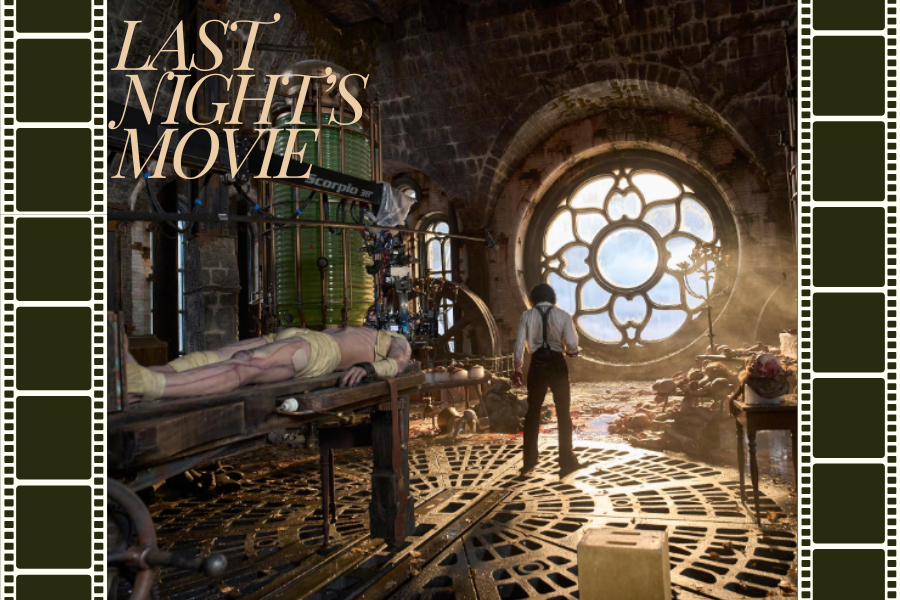
Additionally, this film has set the bar for films to come in terms of visual appeal and aesthetics. The use of lighting and scenery to reflect the tone of scenes while also creating one of the most appealing color pallets we’ve seen in a non-technicolor shot film was expertly done. It is not all monochromatic as one might expect of a gothic tale, rather it utilizes the vibrances and depths of the colors to create this fantastical yet brooding mood. Contrasting scenes employ the use of warm tones and cool tones to perfectly show the divide between the intent of the monster and that of Victor. Warm tones and the imagery of fire are also used to portray Victor’s religious guidance through a guardian angel he is visited by throughout the film. Inversely, the monster is often seen near the water, and later on the ice, amplifying their juxtaposition as characters. This use of color reflects that the forces which many would see morally guiding are seen by Victor as a haunting evil, revealing more layers of his character.
The settings used throughout the film are truly something to marvel at, especially the castle in which Victor both lives and completes his research and construction. The same goes for the costumes, which are period accurate and stunning. We were particularly taken by the clothes worn by both of Mia Goth’s characters, one of which was a dress meant to be reminiscent of overlaying x-ray images, which consequently reinforced the medical motif of the story. Combined, they show a side to the upper class that is interested in intricacy and lavishness in every aspect of their lives.
The only criticism of “Frankenstein” is some of the aspects in which it deviates from the source material. While Mia Goth’s performance connecting with both the monster and Victor is undoubtedly poignant, it simply doesn’t exist in Shelley’s novel, and for good reason. The near-forbidden-romance between Victor and Elizabeth distracts from the more important parts of the story, such as Victor’s self-isolation and manic depression depicted in the book while he’s creating the monster. In adding this Romeo and Juliet scenario into the plot, it dumbs down the movie as a whole, and subtracts from the heavy themes of life, death and humanity.
All in all, we give this film a 9.5/10. From beginning to end, we were glued to the film, and haven’t stopped thinking about it since. It is inspiring, reflective and a testament to human nature in all of the best ways.