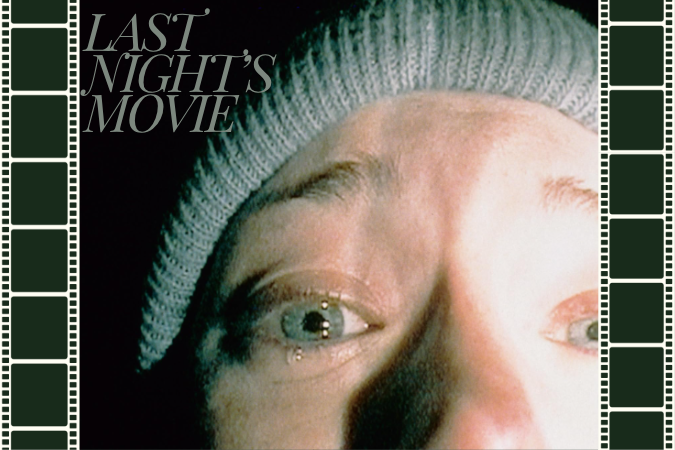
1999’s “The Blair Witch Project” deserves credit for being a first-of-its kind, genre-defying film, but beyond the risk taken in making it, it is severely lacking. The film’s main premise is that it is a “found footage” mystery film in which the main characters are making a documentary on the local legend, the Blair Witch. While this concept is admirable, and could be very well executed, it unfortunately fell short in “The Blair Witch Project.”
The film opens with the friend group of Heather (played by Rei Hance), Josh (Joshua Leonard) and Mike (Michael Williams) preparing to spend a few nights in the woods and gather information about the legend of the Blair Witch from locals. Aside from the four-ish minutes at the end of the movie, this opening is the most eventful it gets. Among the local interviewees is Tammy Brown (Patricia DeCou), the village “crazy lady” who–shocker–turns out to not be as crazy as neighbors make her out to be.
They spend one night in a motel before their trek though the woods, and that scene, though hard to watch in the moment, is retrospectively among the better. Though all of the characters are adults, it felt like a stereotypical teenage film in which the friend group gets their hands on half of a bottle of beer. As Heather, Josh and Mike share a bottle of scotch, they act like they’re breaking every rule in the books despite the legality of the situation. On the second day, the group heads into the woods. After this point, the movie gets hard to watch. The vast majority of footage is just the ground with an occasional pan to one of the characters’ faces.
e of the members. There are sparse moments of poorly executed suspense where the existence of a Blair Witch is alluded to, but there’s nothing concrete. The vast majority of the story is dialogue of the group arguing back and forth. After about 10 minutes of back-and-forth petty argument set to grainy footage of dead leaves and sticks, we could only wonder how much longer it would go on for, despite the movie only having a one hour and 18 minute run-time.
It’s obvious that the arguments shared between the characters are meant to signify a change in all of them. To put it delicately, this “change” is just them taking turns losing it. It’s also obvious that as their bouts of emotion become more and more frequent, we as the audience are supposed to wonder if the Blair Witch is behind their strange behavior. However, this ploy falls flat for two reasons.
First, none of the characters have been established well enough for the audience to gauge the validity of their reactions or whether or not they make sense for them. This makes every scream, every cry in terror and every call for help seem melodramatic and honestly, irritating. The audience can’t be made to feel like the Blair Witch is playing with their minds because the audience hasn’t been made to feel like they know their minds to begin with.
Second, in all of the interviews with locals there’s no mention of the Blair Witch affecting people’s emotions, and there’s really no viable reason to believe the witch can cause insanity. Sure, the audience has this false conclusion shoved in their faces by the actors’ dialogue, but they can’t really be expected to believe it when their only evidence comes in the form of hostile conversations between three immature wannabe-film directors.
The third day brings much of the same, up until Josh goes missing. Then, tensions rise for an actually logical reason, but this tension dissipates just as soon as it arrives with the help of their incessant, childish bickering and the absence of any other real plotpoint. By the movie’s conclusion we were tired of their arguments and sick of squinting our eyes at a black screen hoping to get a glimpse of whatever they were supposedly seeing.
Still, that conclusion ended up being our favorite part. It encapsulated what the entire movie had tried (and failed) to be: Thrilling, uncanny and inexplicable. The shaking camera work makes the most sense in this final scene, and while the recordings aren’t the best quality, that is made up for with the audio. Distant and muffled noises can be heard alongside the character’s screams, while the camera shows its audience next to nothing other than their surroundings. This compels the audience to wonder what could possibly be happening off-screen or even in the shadows of the screen that they can see, and inspires them to conjure their own answers. By making use of the audience’s wild imaginations in this final scene, the directors give “The Blair Witch Project” a fighting chance at being memorable.
The poorly executed suspense, coupled with the unignorable fact that they’re filming very closely to the edge of the woods, add to the overall cringey, tacky feeling of the film. When, three days into being “stranded” in the woods, the characters and their clothes are perfectly clean, it becomes increasingly evident that there were many oversights in production.
Sadly, we can’t pretend that one good scene justifies a high rating of the whole film. In the end, we rated it two out of five stars, out of our appreciation for its ingenuity and our love for the found-footage genre that it helped to create. To put it bluntly, its influence on horror can’t be overstated and neither can our disappointment. “The Blair Witch Project” stands as a horror classic, but if you’re looking for the masterful directing or engrossing storylines shared by its classic counterparts, maybe try looking elsewhere. We’d suggest “The Silence of the Lambs” (1991), “Psycho” (1960) or “The Shining” (1980).